
The Fragmentation of Eelam Tamil Politics: An Inward Crisis
The greatest crisis facing Eelam Tamil politics today is not only the pressure imposed from outside. More dangerous is the internal fragmentation. There are many parties, many groups, many statements, and many voices — but no coherent political direction. Though this fragmentation may appear as ordinary party competition, its roots run deeper, shaped by historical burdens, psychological wounds, struggles for recognition, and unresolved questions of identity.
The Present Forms of Fragmentation
Eelam Tamil politics today is divided across several layers. First, there is competition within the parliamentary arena. Tamil parties claim to represent the same community, yet deep mistrust persists among them. Second, there is the conflict between those who prioritise the memory and ideals of the armed struggle and those who emphasise present political realities and the search for negotiated arrangements. Third, there is the growing gap between diaspora politics and homeland politics — the demands articulated in the diaspora often diverge from the everyday political needs of people living in the North and East. Fourth, there is the struggle among different versions of nationalism itself; the contest over who is the more authentic nationalist frequently shifts from principled debate into a competition for identity and recognition.
These divisions do not exist in isolation. They reinforce one another and turn Tamil politics into a field of continuous internal conflict.
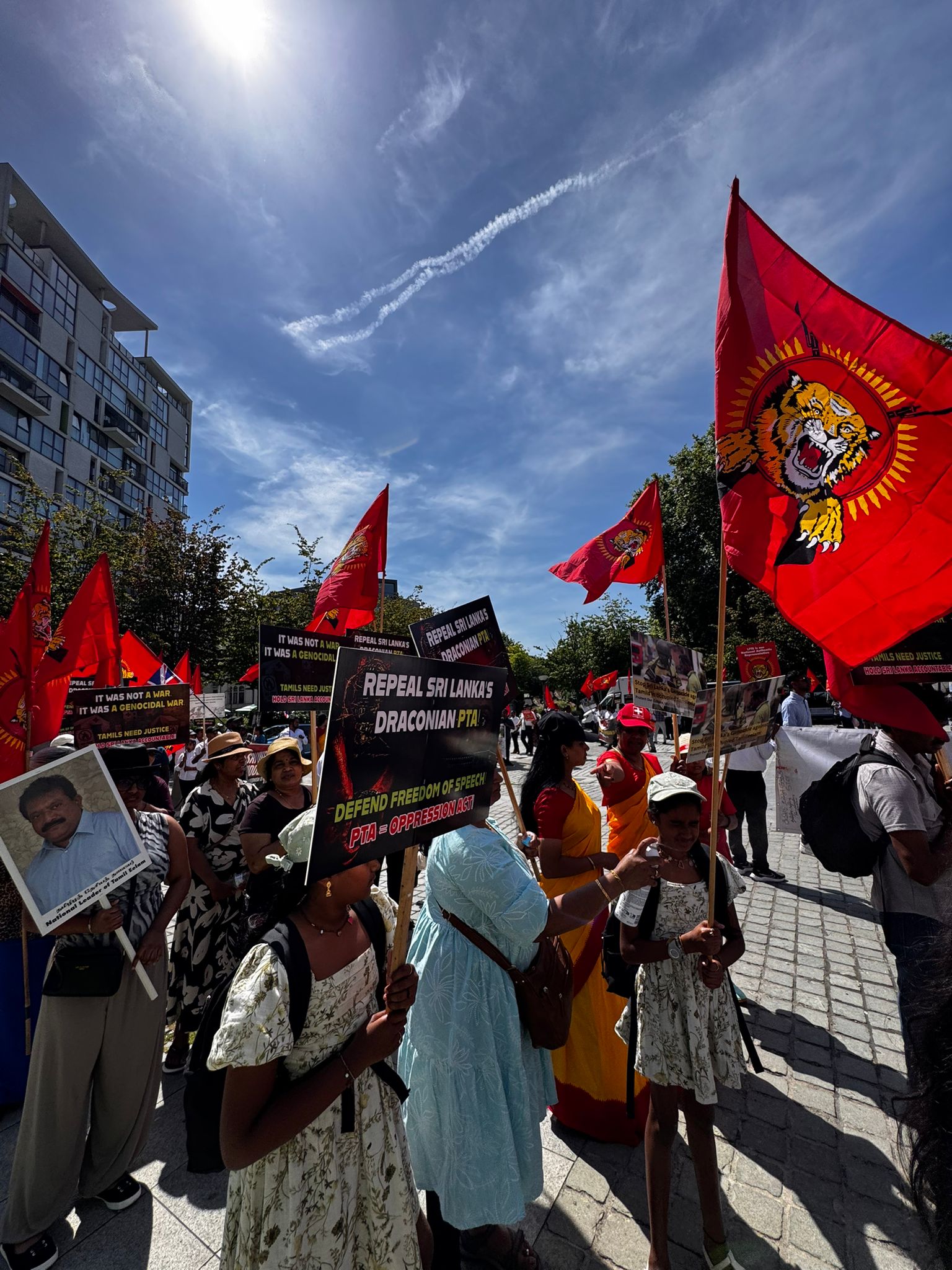 Tamils from across Europe gather in Brussels for the 'Urimaikkaha Ezhu Tamila 2026' march, reaffirming a shared call for Tamil Eelam and the right to self-determination — an example of the unified political direction this essay argues is missing amid today's scattered voices. (Photo: Tamil Guardian)
The Deeper Causes of Fragmentation
Fragmentation cannot be explained merely as a failure of individual leaders. It has layered causes. The first is the collapse of a political centre — after 2009, the centralising force in Tamil politics was destroyed, and in that vacuum many centres emerged, but none secured broad legitimacy. The second is the weight of unfinished history: the suspicions, injuries and contradictions of the armed struggle period remain alive in political memory. The third is the politics of recognition — when individuals and organisations place their own importance and visibility above the collective interest, unity is pushed aside. The fourth is the gap between ideal and reality; no clear political strategy has yet emerged that can connect the language of pre-war ideals with today's military, legal and economic conditions. The fifth is institutional weakness — parties and movements remain heavily dependent on individuals, and without institutional continuity, every disagreement risks becoming a major rupture.
The Consequences of Fragmentation
This fragmentation weakens the Tamil community's capacity to bargain. When a single coherent voice cannot be raised, both the state and the international community find it easier to ignore Tamil demands. Public trust in politics declines. A sense of resignation spreads — the feeling that "all of them are the same." Younger generations increasingly withdraw from political engagement. The diaspora and the homeland begin to speak in different political languages. Most critically, Tamil politics shrinks from being a politics directed against an external structure of power into a politics consumed by internal enemies.
How Should Fragmentation Be Understood?
It is an illusion to believe that fragmentation can be completely eliminated. Differences will exist, and they should exist. Healthy difference is a sign of democratic life. What exists in Eelam Tamil politics today, however, is not healthy difference. It is fragmentation rooted in mutual distrust. When personality clashes and the struggle for recognition outweigh principled debate, difference no longer produces political growth; it produces political paralysis.
The Direction of Recovery
Reducing fragmentation does not mean forcing everyone into a single party. That is neither possible nor necessary. What is required is something more difficult and more serious:
- acknowledging differences of principle while building a minimum common position
- shifting from personality-centred politics to institution-centred politics
- creating a bridge between diaspora sentiment and homeland reality
- treating criticism as a tool of correction rather than a weapon of destruction
- subordinating political competition to the larger purpose of community survival and emancipation
The fragmentation of Eelam Tamil politics is not a temporary administrative problem. It is a crisis that places the political survival of the community itself in question. Until this crisis is honestly acknowledged, even the greatest ideals will remain confined to statements and resolutions.


0 Comments