
The Unspoken Truth: The 'ReeCha' Food Festival and the Ideological Bankruptcy of Eelam Tamil Society
The political decline of a society does not end with the silencing of guns; it reaches its absolute completion only when the collective memory of that nation is systemically erased, transforming its people into mere slaves of consumerism. The fierce debates ignited by the recent mega food festival hosted at the ReeCha Park & Resort premises in Iyakkachchi are not just about heavy overcrowding, food shortages, or management failures. Rather, it has forced us to confront an unspoken truth: where is a nation heading, which once possessed a thirty-year-old history of unprecedented sacrifices that left the world in awe? On the very soil that bears witness to thousands of Maaveerar (martyrs) and the immense sacrifices of its people for liberation and land rights, a vicious consumerist culture is being deliberately imposed under the guise of modernity. The unprecedented sea of crowds jostling, screaming, and fighting over a piece of food reveals a deep ideological vacuum—a stark contrast to the absolute lack of mass mobilization when it comes to organizing protests for political sovereignty or against structural land grabs. The capitalist machinery, in its relentless pursuit of profit, is successfully deploying its ultimate strategy on Eelam soil: numbing the political consciousness of the masses and reducing them to mere unthinking consumers.
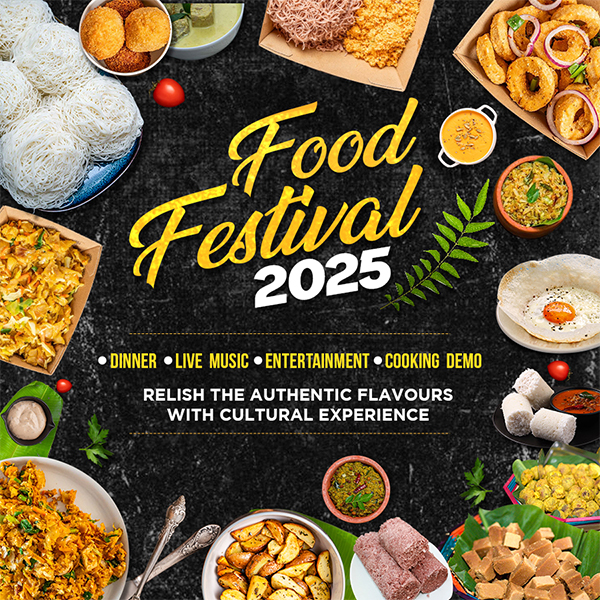 The mega food festival at ReeCha Park & Resort, Iyakkachchi, drew unprecedented crowds. (Image: reecha.lk)
Large corporations like ReeCha project a polished image of eco-friendly greenwashing, branding themselves as organic farms and eco-parks. However, unmasking these contradictions through a Marxist lens reveals a stark reality: while preaching ecology on one hand, they cage animals and foster an elite resort culture that charges exorbitant fees completely detached from the daily realities of the working class. Diaspora capital, aligned with local monopoly capitalism, is effectively commodifying and selling luxury pastimes built on the backs of an ordinary Tamil populace still bearing the deep scars of war. Furthermore, the celebration of liquor and toddy culture embedded within these food festivals systematically targets working-class youth. While state oppression actively enforces land grabs and structural genocide on one side, these commercial carnivals serve as a political sedative designed to deflect the anger and revolutionary instincts of the younger generation. Under the seductive banners of 'taste,' 'celebration,' and 'entertainment,' the combative spirit of the youth is consciously neutralized, herding them into an ideologically castrated crowd.
The class antagonism between the struggling Eelam working class, who face daily economic crises, and these extravagant consumerist festivals is widening. On one side stands grinding poverty, while on the other, an elite class drowned in a superficial 'Instagram-ready' culture splits the social fabric of Eelam into two—an alignment completely antithetical to both Dravidian social justice and Marxist egalitarianism. For the Eelam Tamil nation, which once taught lessons of resistance to the global arena, to fall as easy prey to the capitalist market is a historic betrayal. We must pierce the ears of our society with a sharp question of self-respect: when will the crowds that fought each other for spilled food and fleeting amusement finally hit the streets to reclaim their lost rights and ancestral lands? It is high time the Eelam Tamil nation breaks free from the intoxication of consumerism and resurrects itself as a revolutionary society armed with class consciousness and self-respect—because while the hunger for food is temporary, the hunger for liberation is eternal!


0 Comments