
🚨Broken Statues and Escalating Factions: Is the Future of Eelam Tamils Petty Political Intra-Fighting or the Sublime Dream of Liberation?
The forcible and cowardly removal of the commemorative statue of Thiyagi Lt. Colonel Thileepan from the Nallur Memorial Square by the Sri Lankan state machinery has triggered intense, vitriolic intra-party fighting and mutual recriminations among contemporary Tamil political formations, as extensively documented by the Sunday Times. Under the headline charting the immediate eruption of internal friction following the desecration, the report exposes the deep-seated ideological bankruptcy and structural opportunism defining modern Tamil parliamentary politics. At a historical juncture where the collective national consciousness is confronting a coordinated majoritarian offensive – manifested through the rapid advancement of the proposed PSTA and the restrictive NGO Registration Bill designed to permanently criminalize transitional justice, collective memory, and grassroots civic spaces – our institutional leaders remain utterly fragmented. Instead of mobilizing a unified, transnational diplomatic counter-offensive against the unitary state's systemic impunity, these electoral actors have chosen the path of mutual destruction, reducing a sacred liberation struggle into volatile liquid capital for localized vote-bank consolidation.
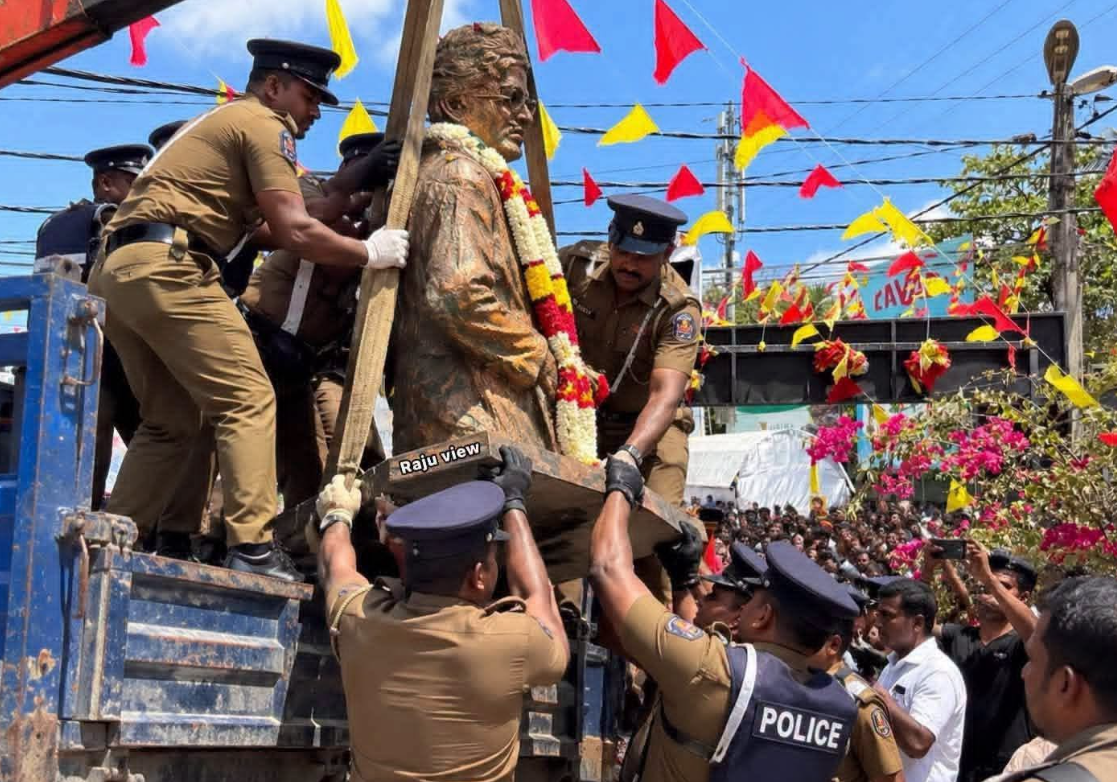 Nallur Memorial Square, Jaffna – site of the commemorative statue of Thiyagi Lt. Colonel Thileepan.
Interrogating this systemic crisis through the analytical prism of Historical Materialism unmasks the bourgeois nature of Tamil Nadu and Eelam electoral politics, where elite bureaucratic structures consistently prioritize parliamentary survival over structural accountability. The undignified spectacle of Tamil political parties trading insults over who holds the ownership or blame for the Nallur monument, while the Tamil masses are still recovering from the trauma of state-sponsored historical revisionism, represents an unforgivable betrayal of the principles Thileepan embodied. During his twelve days of supreme sacrifice without a drop of water, Thileepan did not envision a nation fractured by opportunistic factions chasing parliamentary alms; he envisioned a unified mass collective driven by rigid political intellect. The current willingness of these political formations to engage in petty squabbles while maintaining a complicit silence on the state's covert land grabs and demographic shifts confirms that they have transformed themselves into ideological buffers for the majoritarian center, sacrificing the collective sovereignty of the homeland for transient political privileges.
Global revolutionary history demonstrates that the ultimate containment of systematic state oppression is never achieved through modern legislative compromises or the short-sighted opportunism of parliamentary proxies; it is realized exclusively through the uncompromised mobilization of the common masses. From the sweeping anti-colonial resistance of Algeria to the legendary people's war in Vietnam that successfully brought the world's greatest imperialist superpower to its knees, the decisive factor of victory was always the psychological and physical unification of the population under a structured, uncompromising vanguard. As the architect of Vietnamese liberation, Ho Chi Minh, famously asserted, "The fire of freedom burning within the hearts of the people cannot be extinguished by an occupying army." This is the exact historical law that Thileepan validated through his ultimate martyrdom, encapsulating his thesis in his immortal final cry: "Let the mass revolution erupt, let free Tamil Eelam blossom." Tearing down concrete structures in the dark of night cannot dissolve the sovereign aspirations of our people, nor can the self-destructive maneuvers of electoral politicians dilute the purity of our history.
Therefore, the contemporary Tamil generation across the homeland and the global diaspora must look past the illusions of majoritarian reformism and the deceptive, liberal humanitarian facades projected by the Southern establishment to global bodies like the United Nations. The structural failure of the current administration to rectify past state-centric crimes, while attempting to camouflage its ongoing domestic subjugation under the banner of "equal rights," proves that regime changes in Colombo do not alter the core chauvinistic state mentality. The genuine defense of our nation lies in permanently bypassing these compromising parliamentary formations and organizing our civil society under a rigid, intellectually driven transnational movement. Translating our shared historical trauma into an active, strategic mass mobilization to protect our territorial integrity and reclaim our absolute right to self-determination remains the defining historical responsibility of every committed nationalist. The blood of our martyrs must never become the ink for commercial box-office receipts or electoral compromises; it must remain our eternal shield.


0 Comments